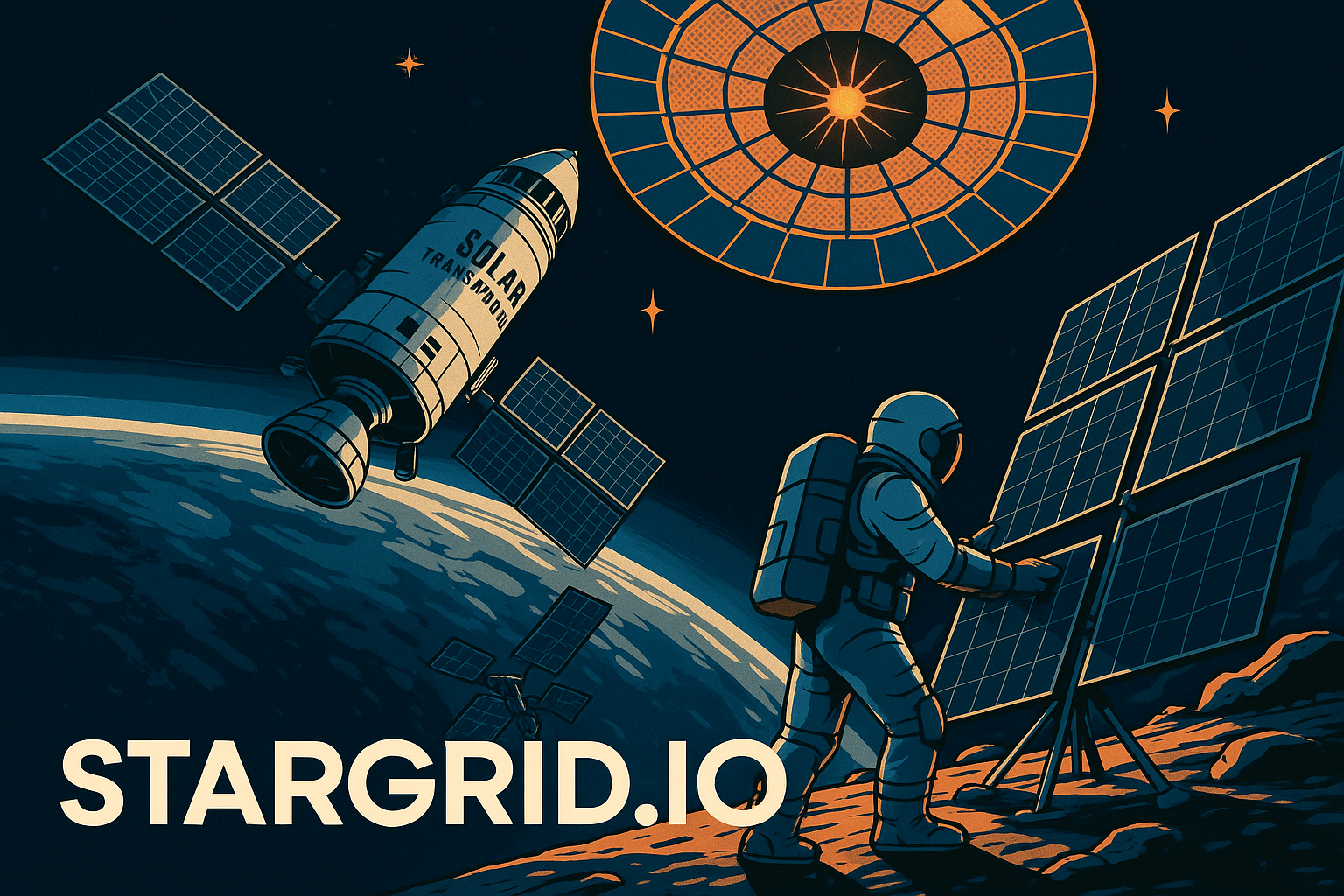
Rim Generation
Sun-tracking, high-efficiency solar arrays at candidate illuminated rim sites.
Lunar Energy Infrastructure · STARGRID.IO
From high-illumination crater rims to permanently shadowed resource zones, STARGRID is designing the wireless energy backbone of autonomous lunar operations—before hardware reaches the surface.
Part of the EXOTESLA.IO TwinOS lunar digital-twin environment.
Featured Mission · Shackleton Crater
Lunar South Pole · Digital Twin Demonstration
The scenario places vertical solar arrays and directed laser transmitters at candidate high-illumination rim sites. Terrain-verified line-of-sight paths connect them to fixed, buffered receivers serving prospectors, excavators, haulers and ISRU systems below.
Open the featured video on YouTube ↗01 · Generate
Solar collection on accessible crater-rim terrain
02 · Transmit
Modeled laser corridors with verified terrain line of sight
03 · Distribute
Stationary receiver nodes buffer and serve mobile loads
Research and simulation footage. Terrain line-of-sight verification does not establish delivered laser power, hardware qualification or continuous site illumination.
Technical Walkthrough
The broader EXOTESLA.IO TwinOS scenario coordinates power delivery with sensing, communications, navigation, resource prospectivity and robotic activity across Shackleton Crater.
18
Modeled operational assets
2
Rim beacons
3
Resource sites
In the demonstrated model, all three laser-power targets have verified terrain line of sight. Candidate energy links, receiver placement, autonomous routes and power-allocation scenarios are evaluated together.
Volatile-prospectivity overlays identify evidence-guided candidate areas—not confirmed ice deposits. Counts and checks refer to this simulation configuration.
Lunar Power Stations · Infrastructure Vision
STARGRID's larger vision connects fixed solar farms, concentrator stations, mobile energy assets and local microgrids—from illuminated crater rims to volcanic plains and industrial sites.
From energy generation to a shared lunar service.
The concept links solar generation, directed energy transfer, local storage and distribution to the industrial customers that need them. Power infrastructure becomes a planning and coordination layer for robotic exploration, processing and settlement growth.
☀ Solar Megafields
Candidate fixed arrays, sun-tracking concentrators and adaptable generation sites.
⚡ Shared Microgrids
Receiver stations, energy buffering and distribution to industrial loads.
🏗 AstroFab.IO
Future manufacturing and construction workflows for power infrastructure.
🌕 Lunar Exchange
A prospective marketplace for contracted energy services and surplus capacity.
Concept visualization, not a deployed lunar electricity network. Actual duty cycle, beam efficiency, thermal constraints, receiver safety and commercial delivery remain to be demonstrated.
System Architecture
Instead of treating every rover as an isolated power system, STARGRID investigates fixed energy infrastructure that multiple missions can access through local distribution.
Sun-tracking, high-efficiency solar arrays at candidate illuminated rim sites.
Directed energy links planned against terrain visibility and operational safety constraints.
Stationary reception, local storage and distribution near work sites in shadow.
Coordinated prospectors, excavators, haulers and resource-processing systems.
The Connected Ecosystem
The Shackleton scenario combines energy planning with terrain, robotics, resource evidence and situational awareness. The objective is to test infrastructure as a coordinated service—not as a standalone animation.
The operational digital-twin environment for lunar infrastructure and mission planning.
Sensor and communications beacons, asset awareness and infrastructure monitoring.
Volatile-prospectivity interpretation and excavation or processing scenarios.
Regional navigation context and local 250 m tactical hexagonal grids.
Manufacturing and assembly concepts for scalable lunar energy structures.
Prospective off-world energy-service trading and industrial-market coordination.
From Engineering to Energy Markets
STARGRID's broader architecture envisions registering power infrastructure, verifying delivered energy, and enabling programmable energy contracts across lunar, orbital and eventually planetary networks.
Associate power producers and service endpoints with verifiable identifiers, technical metadata and operating constraints through AstroProtocol.IO and Cislunar.ID concepts.
Develop production, delivery and consumption records that can support auditable settlement and StarGrid oracle verification.
Explore StarGridCredits (SGC), energy service contracts, tokenized asset models and future settlement workflows.
The marketplace architecture describes product and protocol goals; it should not be read as proof of commercial lunar energy deliveries or fully deployed on-chain metering.